Grant Budget Example for a Small Business: Build a Clear Use-of-Funds Plan
Move from activities to supportable line items, explain the math in a budget narrative, and test matching funds, payment timing, and federal cost principles only when they apply.

Quick answer
What should you know first?
A useful small-business grant budget begins with the sponsor’s current rules and the project activities—not a round request amount. Show each item’s quantity, rate, purpose, timing, funding source, and support. Then reconcile the line-item table, budget narrative, project schedule, matching funds, and payment plan.
Jump to a section
- What is a grant use-of-funds plan?
- 1. Start with the sponsor’s rules—not a generic template
- 2. Convert activities into costs
- Fictional small-business grant budget example
- 3. Document quotes and assumptions
- 4. Write a budget narrative that explains necessity and math
- Direct versus indirect costs
- Matching funds and in-kind contributions
- Reimbursement grants and cash-flow planning
- When federal cost principles apply
- Final budget consistency check
- Build a budget a reviewer can follow
A strong grant budget translates a proposed project into quantities, rates, timing, and responsibilities a reviewer can test. If the narrative says you will improve production, the budget should identify the people, equipment, supplies, and services needed—without unrelated purchases or vague lump sums.
This practical grant budget example for small business applicants also shows how to build a use-of-funds plan. Every company, sponsor, award, deadline, quantity, rate, and dollar amount in the worked example is fictional and for instruction only. It does not establish that any cost is eligible; the current funding notice, sponsor instructions, written answers, and award terms control.
Grants.gov says federal pre-award review can include completeness, programmatic, and financial review, with agencies analyzing budget lines and the overall request for compliance. Use the same mindset for any application: make each cost easy to trace, explain, and verify.
What is a grant use-of-funds plan?
A use-of-funds plan explains what grant money would pay for, when spending would occur, and why each cost is needed. It may appear as a spreadsheet, online form, narrative, quote attachment, milestone schedule, or combination of these.
A credible plan lets a reviewer answer five questions:
- Is the expense permitted? The sponsor’s rules allow the cost, applicant, activity, and timing.
- Is it connected? The line item supports a named project activity or deliverable.
- Is the amount supportable? A calculation, quote, catalog price, payroll record, or documented assumption explains it.
- Is it complete? The plan includes the resources required to perform the work, including any required match.
- Does it reconcile? Budget tables, forms, narrative, milestones, and the requested amount all agree.
A budget is not a shopping list or a promise of results. Say spending *is intended to* or *will support* defined activities. An award does not guarantee revenue, hiring, commercialization, or another business outcome.
1. Start with the sponsor’s rules—not a generic template
Before estimating, create a one-page “budget rules” sheet from the current notice and attachments. Grants.gov describes a federal Funding Opportunity Announcement as the source of pertinent requirements for assessing eligibility and fit. Other sponsors may use different terminology; read their actual materials.
Capture these items:
- minimum and maximum request;
- eligible and prohibited uses;
- project start date, end date, and period of performance;
- required categories and forms;
- whether tax, shipping, installation, maintenance, or pre-award costs are eligible;
- treatment of equipment, inventory, marketing, owner compensation, debt, and working capital;
- quote or bid requirements and quote-validity dates;
- direct-cost and indirect-cost rules;
- matching or cost-sharing amount, formula, source, and documentation;
- payment method, such as advance, milestone payment, or reimbursement;
- whether budget revisions need prior approval; and
- rounding, file-format, page-limit, and signature requirements.
Do not assume a familiar category is allowed. “Marketing” might be eligible, capped, or excluded, depending on the program. Equipment definitions may differ from your accounting system. If an instruction is unclear, use the sponsor’s contact process and save the written answer.
Federal registration is opportunity-specific groundwork. Grants.gov says an organization applying there needs an active SAM.gov registration; registration is free and renewal is annual. SAM.gov says a prime applicant for federal assistance needs registration, not only a Unique Entity ID. This does not automatically apply to private grants.
2. Convert activities into costs
Build the project plan first. Start with activities and deliverables, then identify the resources each requires. This “activity-to-cost” sequence reduces padded estimates and missing dependencies.
Use the following workflow:
Step 1: Define the boundary. State what begins, what ends, and what ordinary operations remain outside the grant. “Install a packaging station” is narrower than “grow the business.”
Step 2: List activities in order. Examples include confirming specifications, procuring equipment, configuring a system, training staff, running a test batch, and collecting data.
Step 3: Identify cost drivers. List hours, rates, units, unit prices, months, freight, setup, and other drivers. Avoid unsupported lump sums such as “technology—$8,000.”
Step 4: Choose support. Mark each estimate as a quote, published price, invoice, payroll rate, written policy, or planning assumption. A quote supports an estimate; it is not purchase approval.
Step 5: Assign funding and timing. Identify whether grant funds, applicant cash, or accepted in-kind support covers the cost, and when cash is needed.
Step 6: Test alternatives. Note what can be reduced if an award is smaller. Explain a scalable version only if the sponsor permits one.
Fictional small-business grant budget example
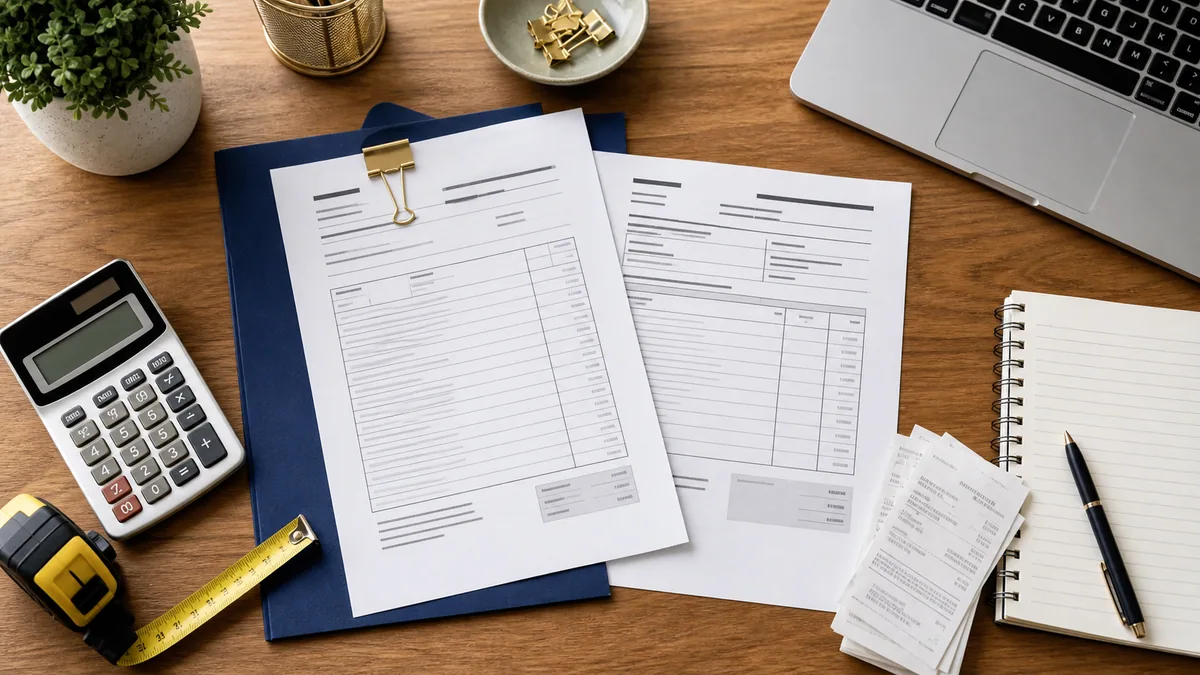
Assume Fictional Cedar Lane Foods LLC is applying to the fictional Main Street Production Readiness Grant. The fictional project would configure a small packing station, integrate wholesale ordering, train staff, and establish basic project tracking. In this teaching scenario only, the fictional sponsor permits the listed costs, allows an indirect line equal to 10% of eligible direct costs rounded to the nearest dollar, and requires a $5,000 applicant contribution for a $25,000 request.
All figures, rates, formulas, names, and sponsor provisions below are fictional. A real applicant must replace them with its own records and the real sponsor’s instructions.
| Fictional budget line | Fictional calculation | Grant funds | Applicant contribution | Fictional support/assumption |
|---|---|---|---|---|
| Project coordinator wages | 150 hours × $30 | $4,500 | $0 | Current fictional payroll rate; hours tied to schedule |
| Payroll-related costs | 10% × $4,500 | $450 | $0 | Fictional documented employer rate |
| Packing-station equipment | 1 unit × $4,200 | $4,200 | $0 | Fictional written vendor quote |
| Food-safe tables and shelving | Package price | $2,000 | $0 | Fictional written vendor quote |
| Packaging and label test run | 2,000 units × $0.85 | $1,700 | $0 | Fictional supplier estimate |
| Wholesale system consultant | 40 hours × $90 | $3,600 | $0 | Fictional scope and rate quote |
| Product photography | 10 items × $120 | $1,200 | $0 | Fictional quote; assumed eligible here only |
| Staff training | 3 sessions × $300 | $900 | $0 | Fictional trainer quote |
| Freight and installation | Fixed estimate | $1,000 | $0 | Fictional vendor estimate |
| Evaluation setup | 20 hours × $60 | $1,200 | $0 | Fictional consultant estimate |
| Compliance review | 15 hours × $95 | $1,425 | $0 | Fictional professional-services quote |
| Project software | 8 months × $69 | $552 | $0 | Fictional published subscription price |
| Direct-cost subtotal | $22,727 | $0 | ||
| Indirect/administrative costs | 10% × $22,727 = $2,272.70, rounded | $2,273 | $0 | Fictional sponsor rule; not a universal rate |
| Owner project oversight | 80 hours × $35 | $0 | $2,800 in kind | Fictional rate and time estimate; assumed accepted |
| Donated training room | 8 uses × $150 | $0 | $1,200 in kind | Fictional documented fair-value assumption |
| Applicant-funded materials | Fixed cash amount | $0 | $1,000 cash | Fictional applicant commitment |
| Totals | $25,000 | $5,000 | Fictional total project value: $30,000 |
The arithmetic is visible: $22,727 in fictional direct costs plus $2,273 in fictional indirect costs equals the $25,000 fictional request. Adding the $5,000 fictional contribution produces a $30,000 fictional project total. The match is shown separately so it is not mistaken for grant-funded spending.

3. Document quotes and assumptions
Create a backup folder and give each quote or assumption an ID matching the workbook, such as `Q-01 Equipment` or `A-03 Owner Time`.
For quotes, record vendor, date, expiration, specifications, quantity, base price, delivery, tax treatment, and exclusions. Make sure the quoted item matches the narrative, and follow any multiple-bid or procurement rules.
If a quote is impractical, document the estimate: “eight months at the published monthly price accessed on the date shown” or “150 hours based on 10 hours per week for 15 weeks.” Save dated price evidence and recheck it before submission. Use a contingency only when expressly permitted and properly presented. Tax, rebates, shipping, and price-change treatment depend on the applicable rules.
4. Write a budget narrative that explains necessity and math
A budget table states *what* and *how much*. A budget narrative explains *why*, *how calculated*, *when*, and *which activity benefits*. Organize it in the same order as the required form so reviewers can cross-reference quickly.
Here are three fictional narrative examples based on the fictional table:
Notice what these examples do not say. They do not claim that the equipment will guarantee sales, that the quoted vendor will necessarily be selected, or that every sponsor allows these expenses. They define a need, calculation, boundary, evidence source, and timing.
Direct versus indirect costs
In everyday budgeting, a direct cost can be traced to the project with reasonable accuracy, such as project labor, a specific consultant, or project supplies. An indirect cost supports shared operations and is not readily identified with one project, such as general accounting or administrative infrastructure. Sponsor definitions differ, and some programs prohibit indirect costs.
For federal awards subject to 2 CFR Part 200, §200.413 ties direct costs to a particular cost objective and requires consistent treatment in like circumstances. Section 200.414 addresses indirect costs and gives certain recipients without a current negotiated rate an optional de minimis rate of up to 15% of modified total direct costs. It is not a private-grant default, is not mandatory, has exclusions and exceptions, and does not necessarily use every direct cost in its base.
Never charge the same expense directly and through an indirect pool. Record the rate, base, exclusions, rounding, and authority. The fictional 10% line exists only because the fictional sponsor permits it.
Matching funds and in-kind contributions
A match is approved project support from a non-grant source. It may be required or optional, cash or in kind. A “20% match” could mean 20% of total project cost or 20% of the request; use the sponsor’s definition.
Cash match might include applicant-paid eligible materials. Accepted in-kind support could include documented labor, donated services, space, or equipment use. Record dates, hours, purpose, valuation, contributor, and evidence; never count a contribution twice.
When 2 CFR §200.306 applies, federal cost sharing generally must be verifiable, necessary and reasonable, allowable, budgeted when required, and not counted for another federal award. The section also addresses valuation and documentation of third-party services and property. These are not universal private-grant rules.
Do not volunteer match merely for appearances. A promised contribution may become an award obligation.
Reimbursement grants and cash-flow planning
An approved budget does not show when cash arrives. Programs may use reimbursement, advances, or milestone payments. Read the payment clause, not only the award amount.
For reimbursement, schedule the purchase, invoice, payment, claim window, required documents, expected review, and conservative receipt date. Calculate the highest cumulative amount the business may need to carry. Include vendor deposits and financing due dates, but do not assume financing charges are eligible.
Before applying, ask:
- Must the business pay vendors before requesting reimbursement?
- How often may claims be submitted?
- What proof is required—invoice, receipt, cleared payment, payroll record, or progress report?
- Are partial reimbursements possible?
- Is retainage used?
- What happens if a cost changes or a vendor substitution is needed?
- Can the business complete the project if payment is delayed?
For recipients covered by 2 CFR §200.305, federal standards distinguish advance, reimbursement, and working-capital-advance methods. The actual method depends on the award and circumstances; federal grants are not universally reimbursement-only or advance-funded.
When federal cost principles apply
The Uniform Guidance matters when a federal award, pass-through award, or incorporated term makes it applicable. It does not govern every corporate grant.
When applicable, use three basic tests from 2 CFR §§200.403–200.405:
- Allowable: the cost meets applicable conditions, limitations, consistent-treatment requirements, and documentation standards.
- Reasonable: the amount is what a prudent person would incur under the circumstances, considering factors such as ordinary need, sound business practices, award terms, and comparable market prices.
- Allocable: the cost is assigned according to the relative benefit received by the award or other cost objective.
Passing one test does not guarantee the others. A premium machine may relate to the project but be unreasonable; a subscription may be reasonable but only partly benefit it. A documented purchase can still be prohibited.
Check selected-item rules and agency terms before treating a category as eligible. Conditions may impose tighter limits or prior approval. Ask the sponsor or a qualified advisor when professional interpretation is needed.
The SBA describes its small-business grants as limited and highlights specific purposes and delivery structures, including research and development, manufacturing support, exporting, and awards to organizations serving businesses. “Small-business grant” does not necessarily mean unrestricted money paid directly to any business. Verify the applicant and funding path.
Final budget consistency check
Run these checks on the final exported application, not only the working spreadsheet:
- Math: quantities × rates equal each line; subtotals and totals recalculate correctly.
- Request: every form shows the same grant amount.
- Narrative: each budgeted item supports a named activity; each resource promised in the narrative is funded or otherwise available.
- Timing: expenses fall within the allowed period and align with milestones.
- Categories: lines appear under the sponsor’s required headings without double counting.
- Evidence: quote IDs, dates, assumptions, and formulas match the backup file.
- Match: source, valuation, and commitment agree across tables and letters.
- Cash flow: the business can manage the payment method without assuming an unconfirmed advance.
- Rules: caps, exclusions, prior-approval provisions, and indirect-cost treatment have been checked.
- Version control: file names, page limits, signatures, and uploaded attachments are final.
Have someone unfamiliar with the proposal trace three random line items from objective to activity, calculation, source document, and total. If that path is difficult, improve the labels before submission.

Build a budget a reviewer can follow
The clearest plan starts with sponsor rules, moves from activities to cost drivers, documents estimates, and reconciles the budget, narrative, schedule, match, and cash flow. Treat the fictional example as a structure—not approved purchases or standard rates.
Before submitting, replace every placeholder with current, business-specific evidence and reread the complete notice. A transparent budget cannot secure an award, but it gives your team and reviewer a practical basis for evaluating the proposed use of funds.
Official sources and further reading
These sources were accessed on August 2, 2026. Always follow the current opportunity notice and sponsor instructions for the application you are preparing.
- Grants.gov: Pre-Award Phase
- SAM.gov: Get Started with Registration and the Unique Entity ID
- U.S. Small Business Administration: Grants
- Electronic Code of Federal Regulations: 2 CFR 200.403 — Factors affecting allowability of costs
- Electronic Code of Federal Regulations: 2 CFR 200.404 — Reasonable costs
- Electronic Code of Federal Regulations: 2 CFR 200.405 — Allocable costs
- Electronic Code of Federal Regulations: 2 CFR 200.306 — Cost sharing
- Electronic Code of Federal Regulations: 2 CFR 200.413 — Direct costs
- Electronic Code of Federal Regulations: 2 CFR 200.414 — Indirect costs
Questions people ask
Frequently asked questions
How detailed should a small-business grant budget be?
Detailed enough for a reviewer to understand the item, quantity, rate, purpose, timing, and basis without guessing. Follow the sponsor’s format. A small request may need only a few supported lines; a complex or multi-year project may require categories, annual budgets, narratives, and quotes.
Can grant money pay the owner’s salary?
Sometimes, but not automatically. Eligibility depends on the sponsor, the owner’s project role, compensation rules, documentation, and whether the amount is reasonable. If allowed, define duties, hours, rate, and timekeeping. Do not label owner withdrawals or profit distributions as project wages.
Should I request the maximum award?
Only if the eligible project genuinely needs that amount and you can support it. Asking for the maximum is not inherently stronger. Build the scope and cost first, then request the supported amount within the permitted range.
Are vendor quotes required?
Some sponsors require one or multiple quotes; others accept documented estimates at application and impose procurement rules after award. Check the notice. Even when quotes are not submitted, retaining price support improves the estimate and makes later updates easier.
Can I change the budget after receiving a grant?
Possibly, within the award’s revision rules. Some changes are permitted within thresholds; others require prior written approval, and prohibited costs do not become eligible through a revision. Obtain approval before committing funds when the terms require it.
Is matching money always required?
No. Match requirements vary, and some programs have none. If match is required, confirm the formula and eligible sources. If it is optional, do not promise resources your company cannot document or maintain.
What if prices rise after submission?
Use current support, state the estimate date, and follow the sponsor’s rules on contingencies and revisions. You can prioritize a scalable scope if allowed, but should not assume the award will increase. Never alter a vendor quote or hide the difference by shifting costs without authorization.
Are grants free to apply for?
Legitimate grant sponsors do not charge you simply to submit the grant application through their official process. Grants are free to apply for. You may choose to pay for optional research, writing, accounting, or advisory help, but that is separate from an application fee. Verify opportunities on official sponsor pages and watch for impersonation or “guaranteed funding” claims.
Does GrantKing award grants or guarantee approval?
No. GrantKing does not award grants and cannot guarantee approval. GrantKing offers grant-discovery and organization resources for $14.95 one time if you choose to buy them. The grants themselves remain free to apply for, and all eligibility decisions, deadlines, application rules, and awards belong to the relevant sponsor.